


Come un punzone a collo d'oca a freno a pressione risolve le interferenze degli utensili nella piegatura a forma di U
By Author: Mark Hanks
Press Brake Gooseneck Punches are important part of press brake tooling solutions applied to eliminate tooling interference during deep U-shaped bending. Unlike standard straight punches, a gooseneck punch provides additional clearance for long return flanges, preventing manufacturers bend complex sheet metal parts from collision between the workpiece and press brake parts.
This article demonstrates the functionality of a Press Brake Gooseneck Punch and the solving of the interference problem in the creation of U-shaped sections with the use of a case study for the components of a safety cabinet.
1. Perché gli utensili normali dei freni a pressione causano interferenze di piegatura a forma di U
The simplified models of the inner liner and outer shell of the safety cabinet are shown in Figures 1 and 2.
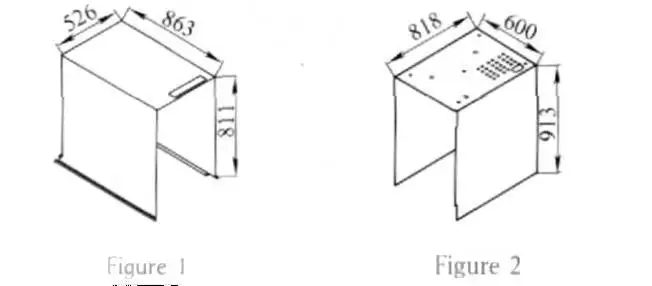
The 3 mm cold rolled steel plate components are formed using a press brake. When the bending action for the inner liner was simulated, an interference issue was detected with the side wall of the inner liner and the front wall of the press brake.
The workpiece and press brake side wall length ratios were determined to be approximately 1.54 and 1.52, respectively. These are both greater than the standard forming range of 1:1 for symmetrical tooling configurations.
Due to the long side walls, a U-shaped section with a length-to-width ratio of near 1 (or above) formed using standard press brake tooling may result in collisions during the folding operation. As shown in Figure 3, the limited space between the workpiece and machine structure can prevent smooth bending without tooling modification.
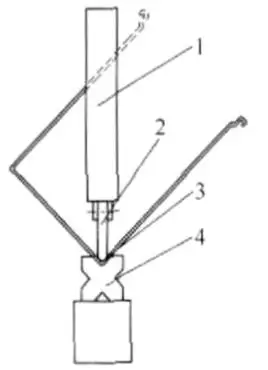
Figura 3: Press-brake-gooseneck-punch-interference-solution.jpg
- Bending Machine 2. Bending Die (Upper) 3. Workpiece 4. Bending Die (Abbassare)
| Parametro | Valore |
| Materiale | Acciaio laminato a freddo da 3mm |
| Length-to-width ratio (liner) | ~1.54 |
| Length-to-width ratio (shell) | ~1.52 |
| Gamma consigliata per gli stampi standard | Approximately ≤1:1 |
Tabella 1
2. Perché i colpi a collo d'oca migliorano la situazione di spazio tra i freni pressa
We examined the tooling for the press brake. The press brake's front panel has a stationary complex large structure that is about 80 mm thick. During operation, this front panel does not move. The worktable of a press brake moves down along with the lower die during bending. Quindi, it is unreasonable and nearly impossible to consider modifying the press brake for the part.
With press brake tooling, proper design enhancements can produce U-shaped part bending results. This requires less effort and does not modify the press brake structure.
A standard press brake die is a left-right symmetrical die with a 45° angle as illustrated in Figure 4. The die movement is in the diagonal line of a square. Using this design, the maximum length to width ratio of a U-shaped part that can be formed is 1:1. Once this ratio is surpassed, one side of the part will hit the press brake and the bending operation cannot be completed.
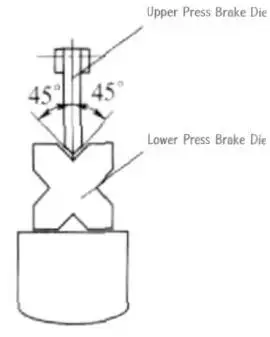
Figura 4
3.Standard Punch vs Gooseneck Punch: Key Differences
When press brake operators select suitable press brake tooling solution, it is important to understand the difference between conventional symmetrical punches and gooseneck punches. Standard punches are suitable for general sheet metal bending applications, but their symmetrical structure generates very few space when forming deep U-shaped parts with long return flanges.
A gooseneck punch uses a special design to create enough working space, allowing previously formed areas to pass through the bending area without interference.
Table 3: Standard-vs-Gooseneck-Punch-Comparison-Table.jpg
| Caratteristiche | Utensili simmetrici standard | Utensili non simmetrici / a collo d'oca |
| Struttura | Simmetrico | Asimmetrico |
| Capacità di formatura | Forme a U | Maggiore flessibilità di spazio |
| Metodo di allineamento | Punte di contatto | In base allo sgombero |
| Idoneità | Forme semplici | Forme complesse con sezioni profonde o strette |
| Complessità di modifica | Bassa adattabilità | Più adattabile |
4. Soluzione: Press Brake Tooling Interference Solution for U-Shaped Parts
This special U-shaped part bending tooling provides additional clearance compared with conventional press brake tooling.
Based on the process evaluation, the interference was mainly caused by the excessive length-to-width ratio of the U-shaped component, which exceeded the capability of standard symmetrical tooling.
To solve this problem, a non-symmetrical gooseneck tooling design was developed as an alternative to conventional left-right symmetrical tooling.
The design concept was based on a planar analysis of the U-shaped part (Figura 5). Point B now denotes the location of point A after being moved 40mm. This is approximately half of the 80mm thickness of the press brake panel. From point B to point C, a line was drawn along a diagonal, splitting the forming angle into 30° and 60° sections.
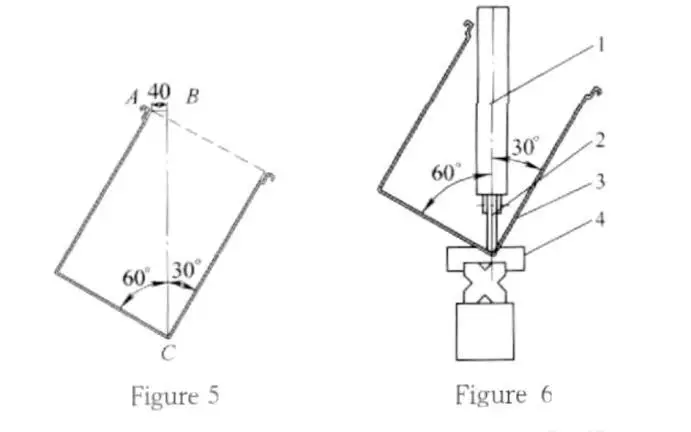
- Bending Machine 2. Bending Die (Upper) 3. Workpiece 4. Bending Die (Abbassare)
Given these geometrical constraints, the manufacturing of the upper punch and the lower die was done as shown in Figura 6. The modified tooling provides more forming capability of the press brake, as it allows more clearance on the longer side of the U-shaped part.
| Componente | Angolo | Scopo |
| Parte sinistra | 30° | Offre spazio per la parete laterale estesa |
| Parte destra | 60° | Garantisce la stabilità della sezione formata |
| Distanza di offset | 40mm | Basato sulla metà dello spessore del pannello |
Tabella 2
5. Metodi di modifica del punzone a collo d'oca per freni a pressione CNC
Two modification approaches were developed depending on the type of press brake being used.
Approach 1: Conventional Press Brake Modification
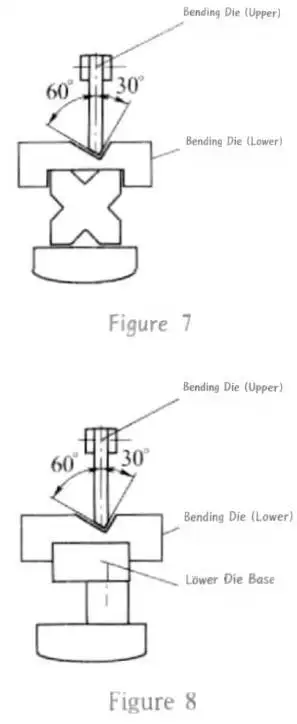
For conventional press brakes, the existing tooling structure is used as the reference base. The original lower die remains installed, while a newly manufactured non-symmetrical lower die is mounted onto it. The upper punch is replaced directly (Figura 7).
This approach provides:
•Lower tooling manufacturing cost;
•Shorter preparation time;
•Simple operation and maintenance.
Approach 2: CNC Press Brake Modification
Per Freni a pressa CNC, an adjustable lower die holder is added between the tooling and machine base. The upper punch is replaced with the customized gooseneck punch (Figura 8).
This solution improves flexibility when producing different U-shaped parts with varying dimensions.
Considerazioni sulla regolazione degli utensili
Adjustment methods for non-symmetrical tooling differ from conventional symmetrical tooling.
For standard tooling, alignment is usually performed by matching the upper and lower tool tips according to material thickness. For asymmetric and gooseneck tooling, tip-to-tip alignment is not advised.
As an alternative, adjustment should be made according to the clearance of the upper and lower tooling:
1.Balance the clearances left and right;
2.Set the clearance to the thickness of the material;
3.Check the tool alignment before starting production.
This method improves forming precision while using the current press brake tools and equipment.
Come scegliere il punzone giusto per il tuo freno a pressione
When choosing a gooseneck punch, manufacturers look at the tensile strength, material thickness and length of the bend as well as the tonnage of the press brake to determine the appropriate tooling.
With every press brake tool, there is a defined limit for the load that is exerted during bending. This is often provided in kilonewtons per meter (kN/m). For standard tooling, this load capacity is between 200 kN/m and 1,000 kN/m. For larger press brakes, with larger tonnage bending applications, special tooling is made of a high strength material.
Some other design considerations include the following:
•Flange heights: This must accommodate the height of the formed flange.
•U-channel depths: This also may require a larger throat or gooseneck.
•Bending clearances: Must accommodate the bending punch, Il pezzo, and the previously formed flange.
•Punch design: The design must define the neck and incorporate the bend angle, Raggio di curvatura, and the height of the bend.
•Tooling design: The punch must define the press brake's clamping system, the die, and the bending operation.
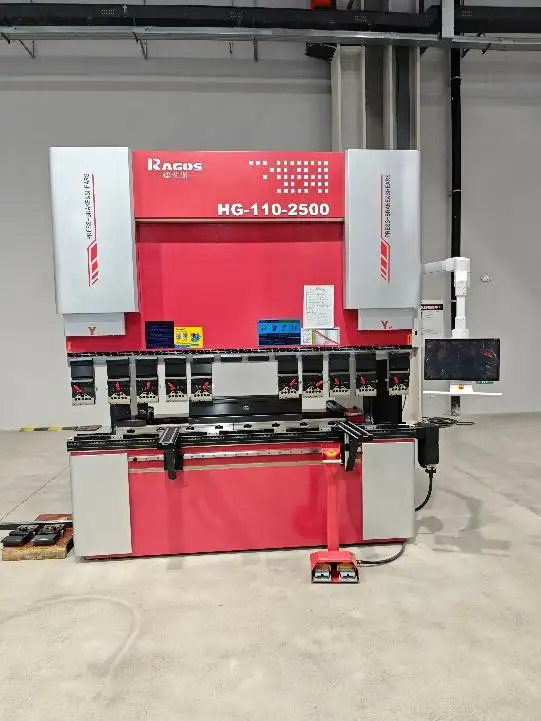
For customers who are unsure which gooseneck punch is appropriate for their application, please contact JS RAGOS. The team provides support for selection, Progetto, and customization of tools to mitigate interference problems in advanced applications involving the bending of sheet metal, given the information for the workpiece drawings and specifications, as well as, Il materiale, Spessore del foglio, length of bend, and the requirements for bending and forming.
Conclusione
The use of a custom designed Press Brake Gooseneck Punch, along with asymmetric tooling, eliminates the problem of U-shaped part bending interferences.
This method expands the forming potential of standard press brakes, and does so without requiring any physical changes to the press brake machine. In real-world production settings, it has the added benefits of a lower cost of tooling, a quicker production set up, and ultimately a simpler production process.
For varying U-shaped part designs, the angles of the punches and dies can be altered to fit the clearances necessary. Gooseneck tooling in this respect, is useful for sheet metal applications with long and narrow channels, and long return flanges.
Table 4: Gooseneck-Punch-selection-Guide-U-Shaped-Parts.jpg
| Caratteristica della parte | Tipo di Utensile Consigliato |
| Length-to-width ratio ≤ 1:1 | Utensili simmetrici standard |
| Length-to-width ratio > 1:1 | Stampaggio non simmetrico / Collo d'oca |
| Flangie di ritorno profonde | Pugna al collo d'oca liberata |
| Larghezza stretta del canale a U | Stampatura a collo d'oca a punta stretta |
| Forme flessibili delle parti | Con utensili regolabili |
With years of experience in manufacturing and assembling of sheet metal processing equipment, JS RAGOS offers precision engineering, coupled with automation, and worldwide service support. From press brakes to tools and even robotic bending systems, our solutions offer you optimized and dependable production.
FAQ
Q1. Are Gooseneck Punches compatible with CNC press brakes?
Definitely. Gooseneck Punches can be adapted to CNC press brakes with custom tooling.
D2. What is the advantage of a Gooseneck Punch for U-shaped parts?
Using a Gooseneck Punch avoids tooling problems when bending deep U-shaped parts with long return flanges.
D3. How does a Gooseneck Punch avoid collisions?
Because of its offset body, the design gives extra space to allow the formed flange to pass through.
D4. Will a Gooseneck Punch enhance the capability of a press brake?
Definitely, a Gooseneck Punch enables the forming of parts outside the standard limits.
Q5. What parts are suited to a Press Brake Gooseneck Punch?
A Gooseneck Punch is best for deep channels, U-shaped parts, and parts with long flanges.
Q6: Can gooseneck punch be used for deep flange bending?
Sì. A gooseneck punch for deep flange bending can provide extra spaces for flanges and prevent collision in the bending process.
Q7. What is the difference between a standard punch and a gooseneck punch?
Standard punches are suitable for normal bending applications, while gooseneck punches can creates extra space for deep channels and long flanges bending.
Q8. Can a gooseneck punch prevent press brake collision?
Sì. Gooseneck punch can reduce interference between the formed flange, and press brake parts. But gooseneck punches are not universal for all kinds of press brake collision.
Q9. How should I choose a gooseneck punch for my press brake?
Tools selection depends on flange height, Spessore del materiale, bending radius, tooling height, and required spaces, and so on. If you have any doubts with current production, feel free to contact us